Shearing
This site has specific instruction on how to shear the parts of your alpaca. Nice to have to start out with. http://www.gatewayalpacas.com/alpaca-farming/alpaca-shearing.htm
Here is another video about setting up your shears. It covers some new topics. http://www.youtube.com/watch?v=ezqyUQzfqCs
Skirting
Place your fiber on 1"x1" mesh , wire or plastic that has been attached to a frame. The mesh openings allow the dirt, any vegetative matter and second cuts to fall through. A second cut occurs when the Shearer comes back over an area that he/she has already cut. You skirt one side of the fleece and then turn it over and do the other side. Pull out any fiber that is coarse, excessively dirty, or very different in length from the rest.
Skirting Table instructions
http://www.hawksmountainranch.com/skirtingtableinstructions.html
Washing
Once you have the fiber picked clean of debris and second cuts, you are ready to send it to a processor, or wash it yourself. I use a multiple wash process
If your washing machine does NOT agitate on the rinse and spin cycle, then use that. It makes it so much easier. We do not want to make a felt lump of your nice fiber! So if your washing machine agitates, do not use it.
Fill the washing machine with warm, think baby bath warm, water. Add some shampoo or gentle dish detergent. Swish this around with your hand. Now add the fleece, a bit at a time. Dunk it so that the pieces are wet and don't float on the top. Keep adding the fleece until your machine is full, or you run out of fleece. Swish the fiber around a bit to make sure the shampoo is distributed and everything is wet. Let it soak for about 5 minutes then spin the water out.
Remove the fiber from the machine. Fill the machine like you did before, with the warm water and shampoo. Add the fleece and swish. Let soak, then spin.
Now I take a bit out of the machine and put it in the sink with clear warm water. If it is still dirty, repeat the cycle. If it is clean, then take the fleece out of the machine and fill it one more time, but this time, don't add any shampoo. This is your rinse. Swish the fiber a bit and spin out the water.
Now spread it on a screen, the skirting table you built - you built one didn't you? - or put it on a clean sheet to dry. Turn the fiber over occasionally to help it dry. I live on the wet side of Washington, so sometimes this is a challenge.
If your washing machine is not appropriate for this, then the steps are the same, it just takes some ingenuity to get the fiber a bit dryer than soaking wet when you repeat the steps. I have done this process in the sink and the bathtub without too much stress and excessive water all over the bathroom and myself.
Wednesday, May 13, 2009


Wednesday, May 6, 2009
Engaging Alpacas

On average, our alpacas do a pretty good job of ignoring me and going about the business of grazing. They are rather excited about sweet feed and new hay, of course, but it doesn't seem they're really dancing in celebration of my food-procuring abilities.
There are times that our alpacas engage me on a personal level, though, and that's always an interesting experience. I say it's interesting because they seem to be on a completely different mental plane. With dogs, you know where you stand fairly well...after all, they are one of the oldest animal relationships humanity enjoys, and they are by nature pack predators (ergo possess that problem-solving intelligence us predators share). To an alpaca, however, such simple procedures as poop-scooping are a mystical experience. If I keep at it long enough, eventually most of the alpacas will come and stare at me and the rake with a sort of aimless curiosity. Similarly, a new feature to a field is thoroughly sniffed, taken as an opportunity for new games, and eventually accepted and ignored.
It's a bit difficult for me not to anthropomorphize this experience, imagining the alpacas displaying human curiosity and playing human games. I think it's just as much a mistake to assume they are playing thorugh some predetermined psychological process, however.
Really, I think that's a big part of the fun of raising animals of any sort, and especially animals of as removed a mindset as alpacas. What is it that ties us, as living creatures? What games do we enjoy playing? How do we relate to eachother, and what is the content of the character of that relationship? Ultimatly, this too is an aimless curiosity, done for the fun of pondering with no intention of answering with finality.
Wednesday, April 29, 2009
Setting up the Shears
Guest writer: Roxanne
First, read the manual. Heniniger has really good instructions for putting it together and how to tighten everything. However, there are only drawings and no pictures. I thought pictures might help us.
First thing to do when setting up the shears is to put on a sharp comb. This is the one that has all the teeth, or has a name on it like camelid or ovina as shown in the previous blog. Slide the camelid comb onto the two screws. The camelid comb requires no gap between the comb and the machine. Now tighten the screws, very snug. You don't want them falling off when the machine is running!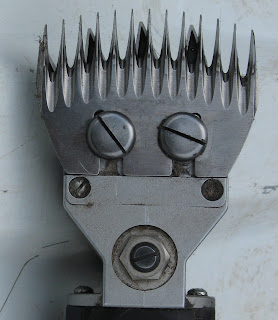
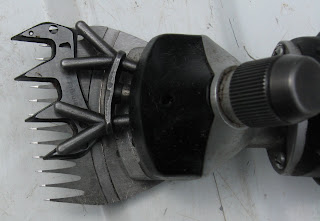
This is how the cutter looks when it is half on. You must first loosen the tensioning knob before trying to put it on. Then attach the post onto the hole in the cutter, slide the other hole onto the next post and tighten the knob clockwise, just enough so that it can't fall off. We will tighten it more later.
 This is how the cutter looks when it is on the machine and slightly tightened.
First, read the manual. Heniniger has really good instructions for putting it together and how to tighten everything. However, there are only drawings and no pictures. I thought pictures might help us.
First thing to do when setting up the shears is to put on a sharp comb. This is the one that has all the teeth, or has a name on it like camelid or ovina as shown in the previous blog. Slide the camelid comb onto the two screws. The camelid comb requires no gap between the comb and the machine. Now tighten the screws, very snug. You don't want them falling off when the machine is running!

The camelid comb should look like this.

This is how the cutter looks when it is half on. You must first loosen the tensioning knob before trying to put it on. Then attach the post onto the hole in the cutter, slide the other hole onto the next post and tighten the knob clockwise, just enough so that it can't fall off. We will tighten it more later.
 This is how the cutter looks when it is on the machine and slightly tightened.
Oil the machine in the groove, between the cutter teeth, in the hole in front of the knob. You can barely see it on the picture above.
Now, adjust the blade tension. Turn the knob until you feel a slight resistance. Start the machine, then loosen the tension. Then retighten until you feel some resistance and the pitch of the machine lowers slightly and it gets a bit louder. You will develop an ear for this and this makes all the difference in shearing being easy!
Now you are ready to shear. Start on a small portion of fleece to see if the shears need adjusting. It should feel like the fiber is falling off, no effort. If it does not cut very easily, then stop and tighten 1/8 turn. Try again.
A couple of hint here.
A link to the How to set up your Shears on Youtube
And a link to a pretty good video of an Alpaca Shearing.
Good luck!
Now, adjust the blade tension. Turn the knob until you feel a slight resistance. Start the machine, then loosen the tension. Then retighten until you feel some resistance and the pitch of the machine lowers slightly and it gets a bit louder. You will develop an ear for this and this makes all the difference in shearing being easy!
Now you are ready to shear. Start on a small portion of fleece to see if the shears need adjusting. It should feel like the fiber is falling off, no effort. If it does not cut very easily, then stop and tighten 1/8 turn. Try again.
A couple of hint here.
- Blades that are too tight get dull and hot fast.
- Blades that are too loose will build up felt under the cutter and you will never be able to tighten it enough. This makes a wedge under the blade so it cannot connect with the comb. In that case, take the blade off, remove the felt, and put it together again.
- Please ensure you do not loosen it to the point the blade falls off when running, scary.
- Never shear towards your hands. I have a friend with a nasty scar from that mistake.
- Be aware of where the on off switch is at all times and any "helping hands".
- Be patient. Being able to shear your own animals is a great freedom. It is worth the trouble to learn blade tensioning.
A link to the How to set up your Shears on Youtube
And a link to a pretty good video of an Alpaca Shearing.
Good luck!
Thursday, April 23, 2009
Shearing in a chute - alone: Part II
Guest Writer: Roxanne
There are several supplies when you are shearing with a chute by yourself:
The shears with sharpened cutters and combs. We use the Heininger shears with the camelid cutters and jet combs, but have mohair and ovina cutters too. They all work. The camelid cutters leave about 1/4 inch fiber on the animal. This is nice for those very pink skinned alpacas to prevent sunburn.
 Heiniger Shears
 Mohair Comb
 Camelid Comb
 Ovina Comb
Oil to lubricate the shears.
We use 30 weight, but that can make a mess on the fiber until it is washed. Never have had it stain, but if you are worried about that, then there is a shearing oil that is white. Oil often as the alpaca does not have lanolin to lubricate the shears and they get very hot otherwise.
An extension cord is an essential component because there is never an outlet where you want to shear.
Good lighting, especially for those dark animals will make shearing that much easier. Portable lights work if you don't have fixtures where you want to shear.
Bags to collect the fiber. Since you as the shearer get to touch the whole fleece, it is easier to sort as you go. There are lots of charts out there that tell you where and what each cut should be, but each alpaca is different and
Feeling the fleece is the ultimate test. If it feels like blanket, and it is on the leg, then add it to the blanket.
A rubber band and small zip lock bag for a fiber sample. Put a handful of fiber in the rubber band before you start shearing, then as you shear that area, put the rubber banded fleece in the zip lock.
3x5 cards. Write on them the animal's name, the date and the grade of fiber, then put it in the bag with the fiber. This information will come in handy.
A chute. I use all 4 of the head ties and the belly bands. Open one side at a time to shear that side. Do not put you head in the way of any legs. From personal experience here, it hurts.
Toenail cutters. As long as you have the alpaca all handy, cut their toenails.
Any shots that alpaca may need. Again, as long as they are there, it is a good time to do shots.
A bag of patience. Really, this is a must. Quit if you get too flustered.
An alpaca vet phone number in case of emergency.
A Doctor's phone number in case of human problems.
Even a young helper will be a big help as they can collect the fiber in the different bags or feed pellets to the alpaca to keep them happy.
There are several supplies when you are shearing with a chute by yourself:
The shears with sharpened cutters and combs. We use the Heininger shears with the camelid cutters and jet combs, but have mohair and ovina cutters too. They all work. The camelid cutters leave about 1/4 inch fiber on the animal. This is nice for those very pink skinned alpacas to prevent sunburn.
 Heiniger Shears
 Mohair Comb
 Camelid Comb
 Ovina Comb
We use 30 weight, but that can make a mess on the fiber until it is washed. Never have had it stain, but if you are worried about that, then there is a shearing oil that is white. Oil often as the alpaca does not have lanolin to lubricate the shears and they get very hot otherwise.
An extension cord is an essential component because there is never an outlet where you want to shear.
Good lighting, especially for those dark animals will make shearing that much easier. Portable lights work if you don't have fixtures where you want to shear.
Bags to collect the fiber. Since you as the shearer get to touch the whole fleece, it is easier to sort as you go. There are lots of charts out there that tell you where and what each cut should be, but each alpaca is different and
Feeling the fleece is the ultimate test. If it feels like blanket, and it is on the leg, then add it to the blanket.
A rubber band and small zip lock bag for a fiber sample. Put a handful of fiber in the rubber band before you start shearing, then as you shear that area, put the rubber banded fleece in the zip lock.
3x5 cards. Write on them the animal's name, the date and the grade of fiber, then put it in the bag with the fiber. This information will come in handy.
A chute. I use all 4 of the head ties and the belly bands. Open one side at a time to shear that side. Do not put you head in the way of any legs. From personal experience here, it hurts.
Toenail cutters. As long as you have the alpaca all handy, cut their toenails.
Any shots that alpaca may need. Again, as long as they are there, it is a good time to do shots.
A bag of patience. Really, this is a must. Quit if you get too flustered.
An alpaca vet phone number in case of emergency.
A Doctor's phone number in case of human problems.
Even a young helper will be a big help as they can collect the fiber in the different bags or feed pellets to the alpaca to keep them happy.
Wednesday, April 22, 2009
Shearing in a chute - alone
Guest writer today: Roxanne
Shearing time is upon us again. We have always sheared our own alpacas, John shears them and I help. Last year though John hurt his back and was unable to complete the shearing. There were 3 alpacas left. So, with 8 years of watching him shear, I thought, I will do the rest in the chute. Alone.
Ambitious plan. I had a chute, I had the shears, I had 3 alpacas in full fleece in June and I had an experienced shearer on the couch to help.
Two out of the three were very patient with me. One was wild. The chute has challenges and many benefits. The challenges are the straps and the working area. The straps are also a benefit. They help hold the alpaca up, but when you get to the belly, it is difficult to shear around them. I would take one of the straps off and shear under it, reattach and repeat with the other one. This works fairly well. I had more of a problem with kicking. But common sense will keep you from getting hurt. Unfortunately, I was devoid of common sense the first time I did a back leg. I was kicked in the face, but no harm done, just my pride wounded.
I had John adjust the shears and change the blades with each alpaca. This helped a great deal, as some of the alpaca's fiber would not cut. Turns out the finer fleeces need the blades tightened more.
Other than the heads looked kinda funny because I sheared around the halter, they turned out okay. The wild one looked like a two year old had taken scissors to it. It is a lesson in strength to hold the Heinengers for that long. It was difficult to float the shears over the alpaca and not make second cuts. I did the blanket, neck, then legs and belly. The chest is actually easier to do standing because there aren't any folds.
If you plan on doing this yourself in a non-emergency situation, I would apprentice to someone first. Getting to know the sound of shears when they are tightened correctly is something one gets with experience and will save you a lot of frustration and time. If the shears are too loose, the blades get felt in between them and they do not cut. If they are too tight, they get hot and dull very quickly. Properly tightened shears feel like you are pushing the fiber off.
At the end of the day though, all the alpacas were sheared. No one was getting heat stress. No one was cut. So it can be done. If you are local to me and would like to help with shearing, or learn to shear, just give us a shout. We usually do shearing on a table as it is much easier to control what is going on. But it takes helpers.
Shearing time is upon us again. We have always sheared our own alpacas, John shears them and I help. Last year though John hurt his back and was unable to complete the shearing. There were 3 alpacas left. So, with 8 years of watching him shear, I thought, I will do the rest in the chute. Alone.
Ambitious plan. I had a chute, I had the shears, I had 3 alpacas in full fleece in June and I had an experienced shearer on the couch to help.
Two out of the three were very patient with me. One was wild. The chute has challenges and many benefits. The challenges are the straps and the working area. The straps are also a benefit. They help hold the alpaca up, but when you get to the belly, it is difficult to shear around them. I would take one of the straps off and shear under it, reattach and repeat with the other one. This works fairly well. I had more of a problem with kicking. But common sense will keep you from getting hurt. Unfortunately, I was devoid of common sense the first time I did a back leg. I was kicked in the face, but no harm done, just my pride wounded.
I had John adjust the shears and change the blades with each alpaca. This helped a great deal, as some of the alpaca's fiber would not cut. Turns out the finer fleeces need the blades tightened more.
Other than the heads looked kinda funny because I sheared around the halter, they turned out okay. The wild one looked like a two year old had taken scissors to it. It is a lesson in strength to hold the Heinengers for that long. It was difficult to float the shears over the alpaca and not make second cuts. I did the blanket, neck, then legs and belly. The chest is actually easier to do standing because there aren't any folds.
If you plan on doing this yourself in a non-emergency situation, I would apprentice to someone first. Getting to know the sound of shears when they are tightened correctly is something one gets with experience and will save you a lot of frustration and time. If the shears are too loose, the blades get felt in between them and they do not cut. If they are too tight, they get hot and dull very quickly. Properly tightened shears feel like you are pushing the fiber off.
At the end of the day though, all the alpacas were sheared. No one was getting heat stress. No one was cut. So it can be done. If you are local to me and would like to help with shearing, or learn to shear, just give us a shout. We usually do shearing on a table as it is much easier to control what is going on. But it takes helpers.
Friday, January 23, 2009
Elegant solutions are the ideal
...while the reality often works out to be something entirely other than "elegant," given the incredible complexity of life. Still, striving towards the ideal often produces insight, so it's not all for naught.
An example: if we are assume our alpacas would thrive given shelter, we're going to need to supply one, in this case a barn. This is a good solution to most weather problems that could threaten our alpacas.
Consider, though, these two things: now there are frequently walked paths, discouraging grass, encouraging mud; and these animals that keep their waste in relatively neat little piles may decide to put one of those piles in their barn. Yes, they are can be relied up to be rascals. So what do you do, assuming you don't want to be sliding in mud and manure every time you go to feed them pellets, and you'd prefer to limit their exposure to the parasites that frequent their waste?
There are a lot of potential solutions to this problem. We have chosen to put a raised matting filled with gravel: this gives us the sturdy walkway of concrete without sacrificing drainage or flexibility.
After a few weeks hay and dirt accumulate in the holes in the matting, restricting drainage and raising the real possibility that the earth will eventually swallow up our little tool, and we'll just be left with a raised mound of mud. So it entails it's own maintenance.
However, you can see with each step we're managing problems of lesser consequence. Ideally, we'll reach a sustainable solution: one that works with, rather than against, the natrual tendencies of the animals and nature in general. In the meantime, though, I'm not slipping onto my behind in poo-mud, so I can't say I'm not happy with progress.
An example: if we are assume our alpacas would thrive given shelter, we're going to need to supply one, in this case a barn. This is a good solution to most weather problems that could threaten our alpacas.
Consider, though, these two things: now there are frequently walked paths, discouraging grass, encouraging mud; and these animals that keep their waste in relatively neat little piles may decide to put one of those piles in their barn. Yes, they are can be relied up to be rascals. So what do you do, assuming you don't want to be sliding in mud and manure every time you go to feed them pellets, and you'd prefer to limit their exposure to the parasites that frequent their waste?
There are a lot of potential solutions to this problem. We have chosen to put a raised matting filled with gravel: this gives us the sturdy walkway of concrete without sacrificing drainage or flexibility.
After a few weeks hay and dirt accumulate in the holes in the matting, restricting drainage and raising the real possibility that the earth will eventually swallow up our little tool, and we'll just be left with a raised mound of mud. So it entails it's own maintenance.
However, you can see with each step we're managing problems of lesser consequence. Ideally, we'll reach a sustainable solution: one that works with, rather than against, the natrual tendencies of the animals and nature in general. In the meantime, though, I'm not slipping onto my behind in poo-mud, so I can't say I'm not happy with progress.
Tuesday, January 20, 2009
The end of one story
You learn a lot of things on a farm. You're so close to so many of the fundamental processes of existence, in the sense you're carefully observing the world around you, and asking yourself questions based on what you see. Why does grass grow? How will the alpacas react to a new food? What purpose do predators serve?
One of the most fundamental processes is more difficult to grapple with, but still omnipresent: the life-death-rebirth cycle. Why do we die? What happens to those who do? Where does new life come from? What is it like to die?
These are not easy questions, in that the basic answers are often unsatisfying. We may take some comfort in knowing that our bodies are of the earth, and our death is simply our return to what we were before birth. We may understand that death is necessary to life. Still, death is uniquely painful to witness.
So it was with Master Po. Without a constant regime of milk, his body was unable to generate enough heat to survive the cold northwest winter, and his rumen (like a cow's stomach) was unable to digest the hay he was filling himself on. Our veterinarian is an hour's drive, and nearing the end of the ride, Master Po died in my arms.
This is not an easy thing to have happen. This is a farm, however: there are no elaborate burial rituals, or services for the departed. In a few days, things are back to normal, maybe with a sense of something being missing, but that too fades. This is farm, which is like saying "that's life," but without the bitterness that phrase is usually said with. "That's life" in that life is what it is, and as a farmer you try and see the sense in things, because you believe in a rational life worth living, and if life entails pain and death and loss, than that too, is life.
One of the most fundamental processes is more difficult to grapple with, but still omnipresent: the life-death-rebirth cycle. Why do we die? What happens to those who do? Where does new life come from? What is it like to die?
These are not easy questions, in that the basic answers are often unsatisfying. We may take some comfort in knowing that our bodies are of the earth, and our death is simply our return to what we were before birth. We may understand that death is necessary to life. Still, death is uniquely painful to witness.
So it was with Master Po. Without a constant regime of milk, his body was unable to generate enough heat to survive the cold northwest winter, and his rumen (like a cow's stomach) was unable to digest the hay he was filling himself on. Our veterinarian is an hour's drive, and nearing the end of the ride, Master Po died in my arms.
This is not an easy thing to have happen. This is a farm, however: there are no elaborate burial rituals, or services for the departed. In a few days, things are back to normal, maybe with a sense of something being missing, but that too fades. This is farm, which is like saying "that's life," but without the bitterness that phrase is usually said with. "That's life" in that life is what it is, and as a farmer you try and see the sense in things, because you believe in a rational life worth living, and if life entails pain and death and loss, than that too, is life.
Subscribe to:
Posts (Atom)